I left home for the first time at 17.
Not for a holiday. For college. Manipal — a small university town on the Karnataka coast, about as far from Bareilly, Uttar Pradesh as you can get without leaving the country. Different language. Different food. Different everything.
Nobody warned me that the first kind of solo travel is the kind you don’t choose.
Manipal — Learning to be alone in a crowd.
Manipal Institute of Technology has students from every state in India. It is one of those places where you arrive knowing nobody, and the only way forward is to figure out who you are when nobody already knows you.
I figured it out by moving. Weekend trips to Chikmagalur and Bangalore. Midnight drives to Udupi because someone had a car and nobody had anything better to do. Beach trips that started as plans and ended as something else entirely.
These were not carefully planned trips. There were no itineraries, no booked experiences, no research. Just a group of people who had nothing in common except proximity — and the shared instinct that being somewhere else, even briefly, was better than staying still.
I didn’t know it then but I was learning the most important thing travel teaches: how to show up somewhere unfamiliar and trust that it will work out.
Oman — The first time the world got bigger.
My first international exposure came through an internship in Oman.
I was 20. I had never left India. I knew nobody there. I arrived in Muscat with a suitcase and a very limited understanding of what I had signed up for.
What I found was a country of extraordinary hospitality, landscapes unlike anything I had seen, and — most unexpectedly — a group of strangers who became, over the course of that internship, some of the most formative people in my life.
Travelling with strangers is its own education. You learn very quickly who people actually are when the social scaffolding of home and history is stripped away. And you learn something about yourself — what you reach for when you’re uncertain, what you find funny, what you notice that others don’t.
Oman taught me that the world outside India was not intimidating. It was just different. And different, it turned out, was exactly what I was looking for.
Columbia — Solo travel as a way of life.
Graduate school at Columbia University in New York put me in one of the world’s great cities with a student visa, a budget, and an appetite for being somewhere new.
I travelled alone through most of it. Not because I couldn’t find company — but because solo travel had by then become something I actively chose. The pace is yours. The decisions are yours. The discoveries are entirely, uncommissioned, your own.
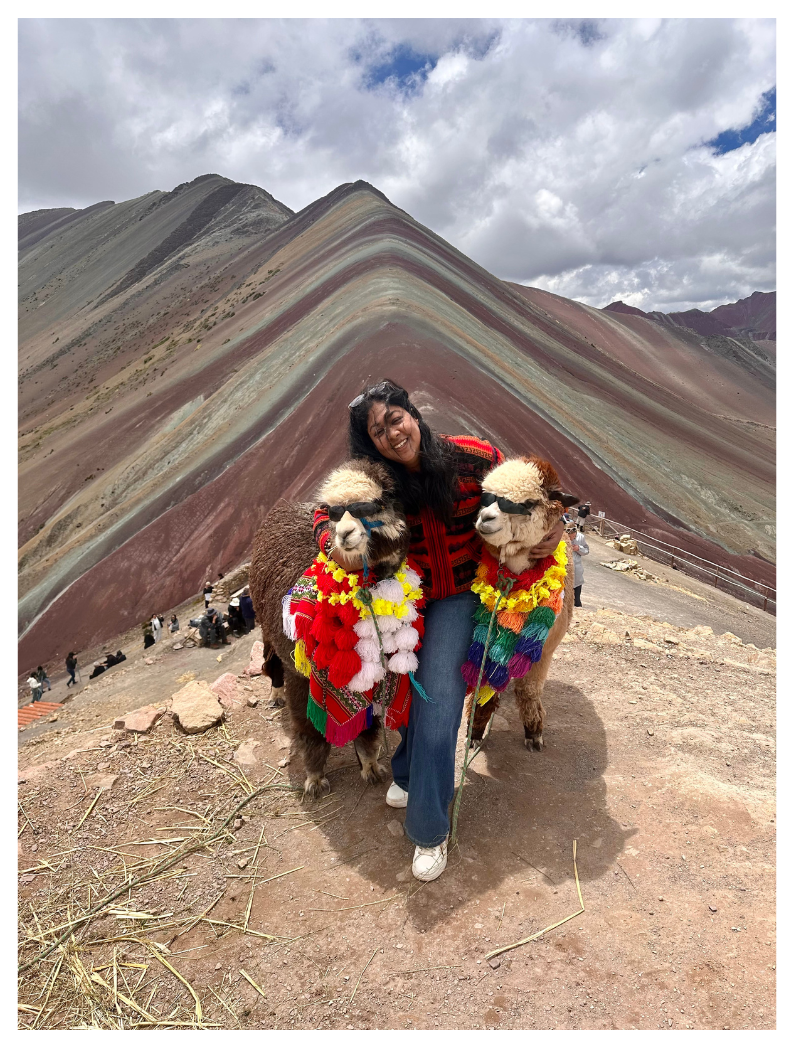
I stood on the summit of Pikes Peak in Colorado and looked out at a landscape so vast it felt personal. Drove through Arizona and pulled over because a wooden frame someone had built in the middle of nowhere perfectly framed the view beyond it. I sat in the streets of Old San Juan in Puerto Rico in a floral dress at golden hour feeling completely, unhurriedly present.
None of these were on any itinerary. All of them are photographs I return to when I need to remember what it feels like to be fully alive.
But here is the thing about solo travel that nobody tells you: the moments that stay with you are almost never the ones you planned. They are the ones that happened because someone — a local, a guide, a host — knew something you didn’t, and trusted you enough to share it.
The best experiences I have had as a solo traveller were handed to me by people who knew their place deeply. A guide in a city I didn’t know. A host who cooked food I had never heard of. A driver who took a different road because he knew it was more beautiful.
Trusted local knowledge is the invisible infrastructure of every good trip.
Coming home — and finding something unexpected.
I came back to India not to return to where I had been — but to arrive somewhere new.
After years of moving across continents for work and study, I landed in Pondicherry. Auroville, to be specific — one of the most unusual places in India, a township built on the idea of human unity, tucked between the Tamil Nadu coast and a quiet stretch of forest. I came to work. I stayed because the place had a way of slowing you down and making you look at things differently.
And everywhere I went in India during this time, I noticed the same gap.
The experiences that had made travel meaningful for me — the local knowledge, the trusted guide, the thing that wasn’t on any platform but was absolutely worth doing — were almost entirely invisible online. The platforms that existed were either too global to care about an adventure operator in Bir Billing, or too aggregated to surface the kind of curated, genuinely worth-your-time experience that changes how you see a place.
India has some of the most extraordinary travel experiences in the world. And almost none of them are properly bookable.
That’s why I built Muussaafirr.
Not as a business idea. As the platform I wished had existed every time I showed up somewhere alone and had to figure it out myself.
Every experience on Muussaafirr exists because someone with deep local knowledge — a pilot who has flown cross-country above the Himalayas, a guide who has walked the French Quarter of Pondicherry a thousand times, a naturalist who knows exactly where the tigers come to drink — agreed to share what they know with the right traveller.
That traveller might be travelling alone. Or with someone they love. Or with a group of strangers who have nothing in common except the instinct to be somewhere else.
It doesn’t matter. The experience is there. The trust is built in.
All you have to do is show up.
Muussaafirr — your friend with hidden gems and off-radar experiences across India.


Share your thoughts